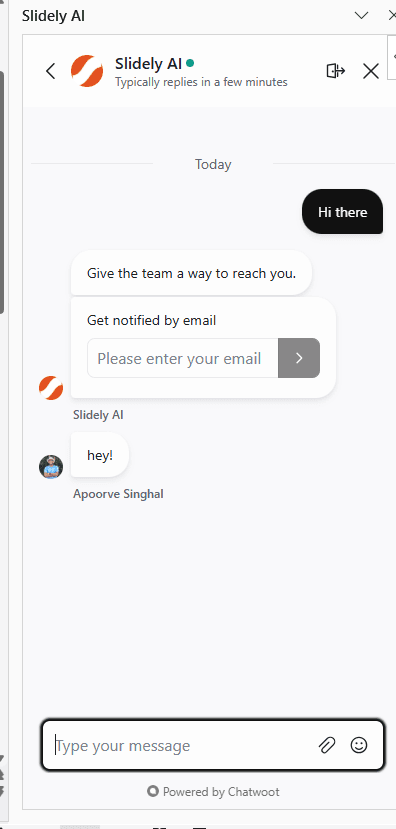
Plus AI and Slidely AI are both AI presentation tools built for people who want to create and edit decks faster. On the surface, they overlap in many of the same areas: both can generate presentations, work inside PowerPoint, edit existing slides, use company branding, and produce native, editable output. But the way they approach the presentation workflow is quite different.
Plus AI is built around fast presentation generation and editing across PowerPoint, Google Slides, and the web. Slidely AI is more focused on the end-to-end professional PowerPoint workflow, from combining source material and researching a topic to planning the storyline, working with complex company templates, editing existing decks, and handling enterprise deployment requirements.
To see how they compare, we tested both products across 20 parts of the presentation workflow, including research, storyline creation, slide generation, templates, redesign, PowerPoint editing, native output, platform support, and enterprise features. Below, we’ll walk through where each tool is stronger, where the differences are smaller, and which types of teams each product is best suited for.
Plus AI vs Slidely AI at a glance
 Plus AI Plus AI |  Slidely AI Slidely AI | |
|---|---|---|
| Best for | Fast AI-generated decks across Google Slides and PowerPoint | Professional PowerPoint workflows with complex templates, data, and iteration |
| Where you work | PowerPoint, Google Slides, web | PowerPoint, web |
| Starting from source material | Prompts and uploaded files | Multiple mixed inputs including PPTX, PDF, Excel, documents, and images |
| Storyline and research | AI agent with research and generation | Research, clarification, storyline planning, and slide-level content review |
| Company templates | Custom templates, with additional setup for complex corporate designs | Uses existing PowerPoint templates, masters, and layouts directly |
| AI editing | Rewrite, Remix, and Presentation Agent | Conversational editing, redesign, multi-slide editing, and deck review |
| PowerPoint output | Native editable PowerPoint | Native editable PowerPoint |
| Enterprise | SSO, administration, security, custom templates | SSO, security, private cloud/VPC, bring-your-own LLM |
| Google Slides | Yes | No |
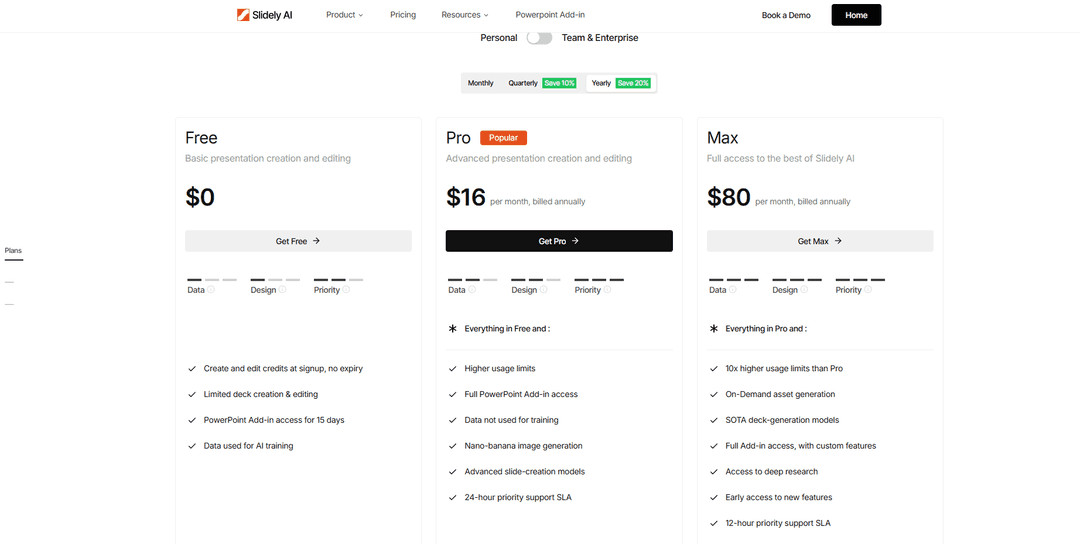
| Free plan | Trial | Permanent free tier |
How we compared Plus AI and Slidely AI
We compared Plus AI and Slidely AI across the full presentation workflow, not just first-draft generation.
That includes how well each tool handles messy source material, research, storyline development, company templates, slide design, editing, re-templating, native PowerPoint output, collaboration, platform support, and enterprise requirements.
For each of the 20 questions below, we looked at what each product actually lets the user do and which workflow is better suited to professional presentation work. Where one product had a clear advantage, it received one point. Where the trade-off was genuinely situational, we scored the category as a tie and gave each product half a point.
The detailed sections below explain the reasoning behind every comparison before we summarize the results in the final scorecard.
Presentation creation
1. How easy is it to give the AI your source material?
2. Can the tool research and enrich the presentation?
3. How well does it plan the storyline and slide content?
4. Can you control the design direction before generation?
5. Can it create high-quality, data-dense slides?
6. How fast and flexible is the creation workflow?
Branding, templates & design
7. Can it use your real company template?
8. Can it learn and reuse your company's design patterns and preferences?
9. Can it help when you do not already have a usable template?
Editing, data & PowerPoint productivity
10. How well can it edit existing slides with AI?
11. How well can it redesign one or multiple slides?
12. Can it re-template slides into a new design system?
13. Can it review and fix consistency across the whole deck?
14. Can it find and improve visual assets?
15. Does it keep everything natively editable in PowerPoint?
16. Does it provide advanced PowerPoint productivity tools?
Platform, user experience & enterprise
17. Where can you use the product?
18. How accessible are pricing and human support?
19. How well does it support enterprise deployment, model control, and security?
20. Can it work with ChatGPT, Claude, and other AI assistants?
Presentation creation
The first part of our comparison looks at everything that happens before a finished deck exists: giving the AI context, researching the topic, developing the storyline, aligning on the design direction, and finally turning all of that into slides.
1. How easy is it to give the AI your source material?
Most presentation work does not start from a clean prompt. Users usually have a mix of inputs: an email from a colleague, a previous presentation, a client PDF, some Excel analysis, a few images, and perhaps a company template. We wanted to see how much of that context we could give each tool upfront, and whether the AI could structure it without forcing us to simplify the problem first.
Plus AI

Plus AI gives users three main ways to start: begin from a text prompt, upload a source file, or configure the presentation slide by slide. Its current upload workflow supports formats including PDFs, Word documents, PowerPoint files, and text files.
This works well when the source material is relatively self-contained. When we wanted to combine several different types of inputs into one brief, however, the workflow felt more constrained. The slide-by-slide option gives more control, but also puts more responsibility for structuring the presentation back on the user.
Slidely AI
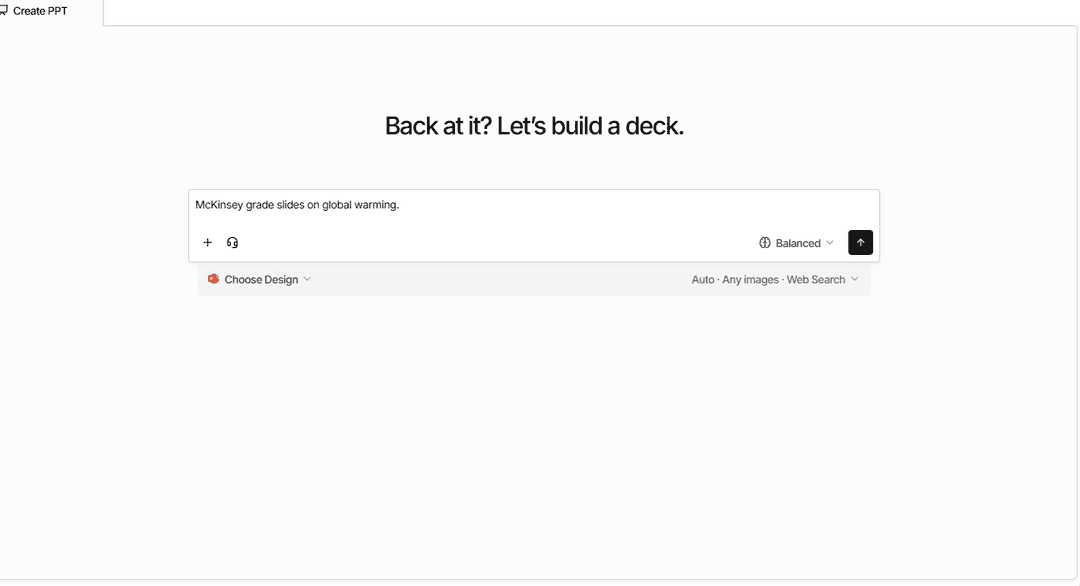
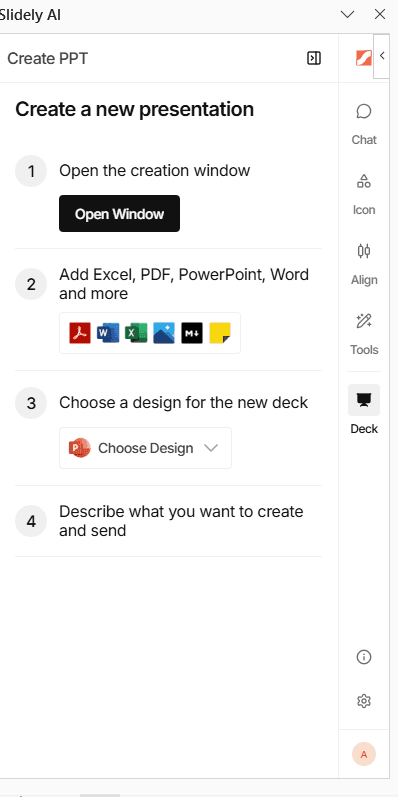
Slidely AI starts with a more general-purpose prompt. We could attach several sources, including presentations, PDFs, documents, spreadsheets, and images, and ask the AI to reason across them together.
We could also provide the company's PowerPoint template alongside the source material, so Slidely had both the content context and design context before it started planning the deck.
Our take
Better: Slidely AI.
Both tools make it easy to start from a prompt or source material. Plus AI works well when the inputs are relatively simple or already structured. Slidely AI is better suited to workflows where the user wants to provide a broader collection of raw material and let the AI help make sense of it.
2. Can the tool research and enrich the presentation?
The files a user provides rarely contain every piece of context needed for a strong presentation. External information can completely change the interpretation of the internal data. A company growing at 20%, for example, looks very different if its market is growing at 10% versus 40%.
We therefore wanted to see whether the AI could go beyond the user's files, find relevant information online, and bring useful evidence back into the presentation.
Plus AI
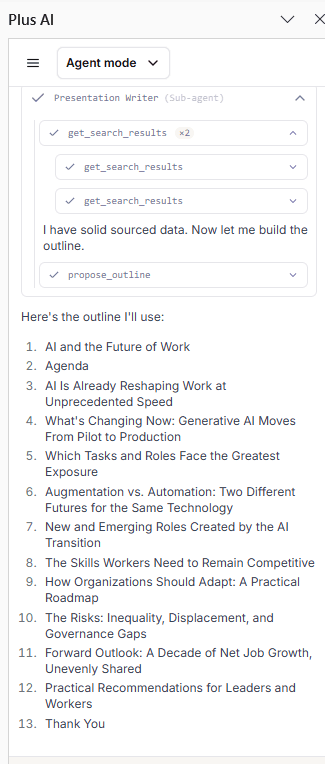
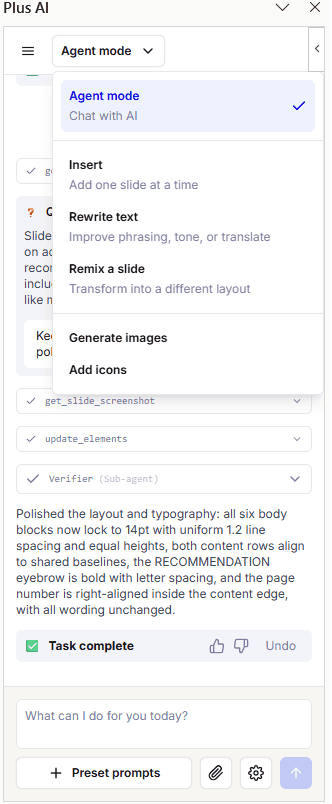
Plus AI's newer Presentation Agent can brainstorm, research, and organize ideas, including helping with market and competitor intelligence.
In our testing, research felt more like a capability of the agent than a dedicated research phase of the deck-building process. Plus can find information to help with a presentation, but there is less emphasis on showing a multi-stage research process before the storyline is finalized.
Slidely AI
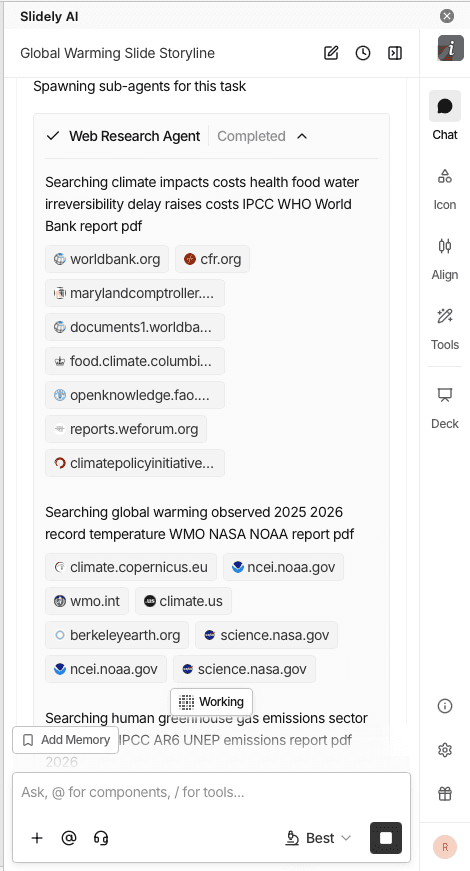
Slidely AI makes web research an explicit part of presentation creation. It can search the web alongside the user's uploaded material and use that research to shape the storyline and individual slides.
The workflow also makes it easier to inspect the information being used before slide generation rather than discovering new external claims only after the deck has been created.
Our take
Better: Slidely AI.
Both products can bring outside information into the presentation. Plus AI's agent is useful for ad hoc research; Slidely AI makes research a more explicit part of the end-to-end process of developing the deck.
3. How well does it plan the storyline and slide content?
A good presentation is not simply a document broken into slides. Before designing anything, the creator needs to decide who the presentation is for, what the audience should take away, how the argument should unfold, and what evidence belongs on each slide.
We wanted to see how much each product helps with that thinking before committing to a finished deck.
Plus AI
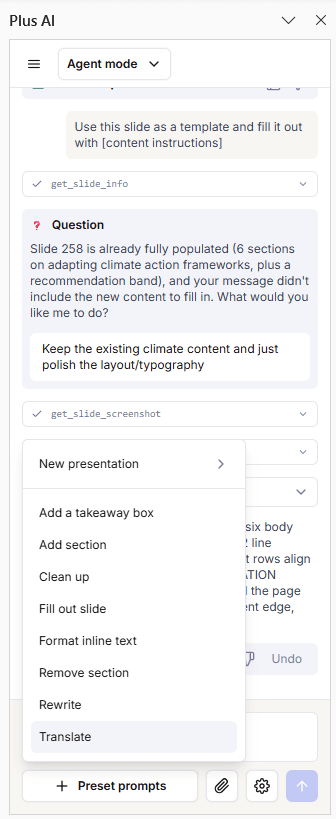
Plus AI's Presentation Agent can plan the story, write the content, and design the presentation from a prompt or an existing deck. Plus AI also supports more structured generation where the user can configure the presentation slide by slide.
The overall experience is optimized for getting from the brief to a usable first draft fairly quickly. Much of the planning happens inside the generation process rather than as a series of explicit checkpoints with the user.
Slidely AI
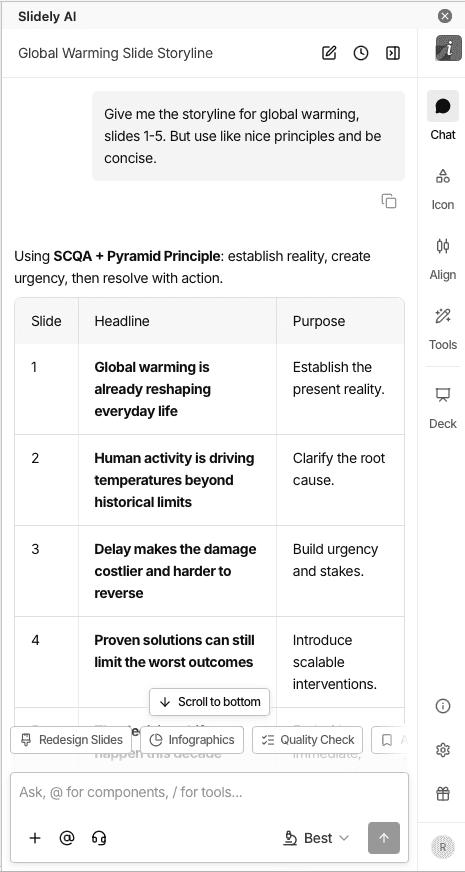
Slidely AI separates more of the planning process from slide generation. It first asks questions to clarify the brief, such as the intended audience and objectives, then develops the storyline and lets the user review the content planned for individual slides.
This creates more opportunities to change the argument before design work begins. Users can refine what belongs in each section and slide rather than waiting for the generated deck to discover whether Slidely interpreted the brief correctly.
Our take
Better: Slidely AI.
Plus AI gets to the first draft more directly. Slidely AI exposes more of the thinking before generation, which is useful when the storyline itself is a significant part of the work.
4. Can you control the design direction before generation?
Even if the storyline and data are correct, there are many ways to visualize the same presentation. Discovering that the AI chose the wrong design direction after generating 30 or 50 slides creates unnecessary rework.
We therefore looked at how much control users have over layouts and visual direction before the full deck gets generated.
Plus AI
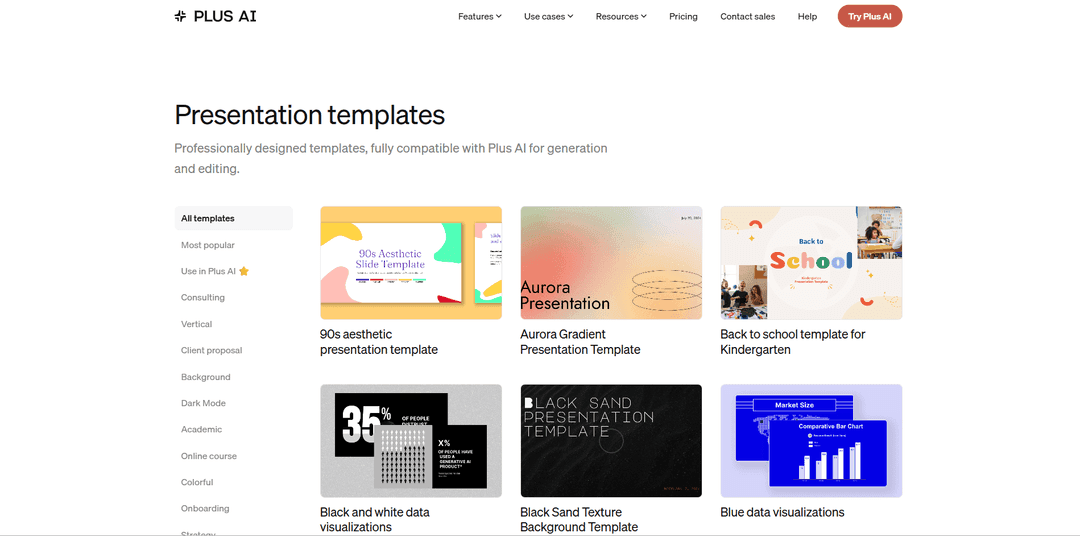
Plus AI has a large library of professional slide designs and can automatically choose layouts based on the content. Users can also choose specific formats and generate variants when they want more control.
This provides good control at the slide level. With complex corporate templates, however, the workflow is still largely about letting Plus choose from the designs available to it rather than explicitly defining a subset of masters and layouts before the deck is built.
Slidely AI
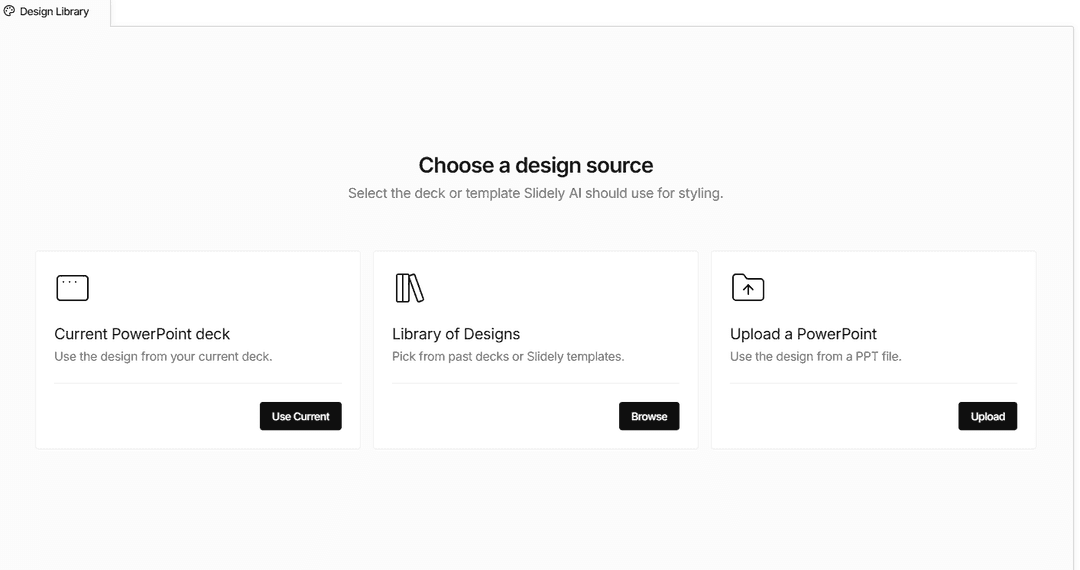
Slidely AI lets users work directly with the layouts inside their PowerPoint template and filter which layouts should be considered for a presentation. It can also recommend layouts based on the content while allowing the user to override those choices.
Before creating the full deck, the workflow can be used to validate slide-level content, layout choices, and sample outputs so that the user and AI are aligned on both content and design.
Our take
Better: Slidely AI.
Plus AI offers strong layout selection and variation during generation and editing. Slidely AI gives more control earlier in the workflow, particularly when the company template contains many different masters and layouts.
5. Can it create high-quality, data-dense slides?
Professional presentations vary enormously in information density. An executive summary might contain one message and a chart; a consulting or financial-analysis slide might contain several charts, a detailed table, annotations, and supporting evidence.
We wanted to see whether the design adapts to the information, or whether the information has to be simplified to fit the design.
Plus AI
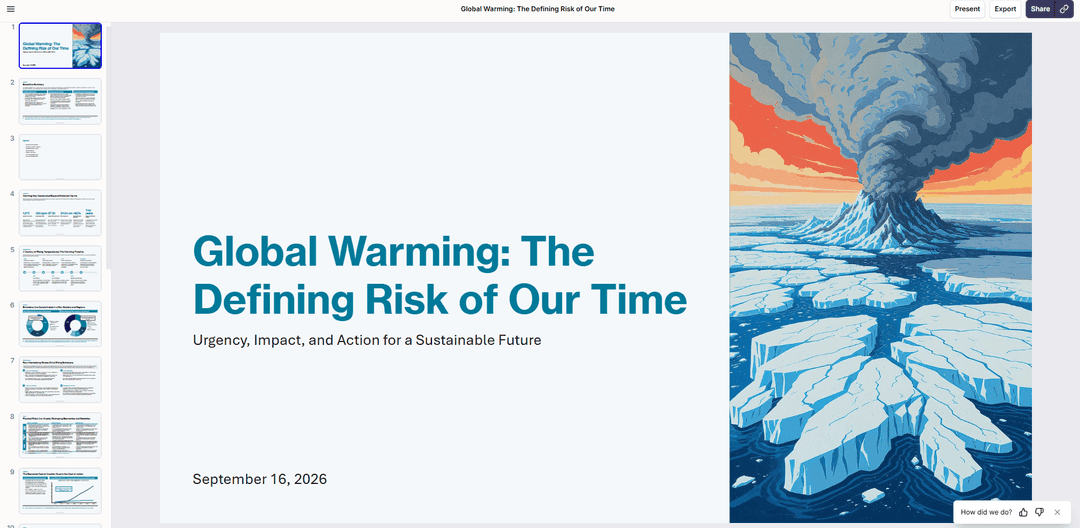
Plus AI creates professional slides from a large library of layouts and supports charts, tables, images, and icons. Charts and tables created by Plus remain editable in PowerPoint and Google Slides.
It works particularly well for quickly turning a clear brief into a polished first draft using established presentation structures.
Slidely AI
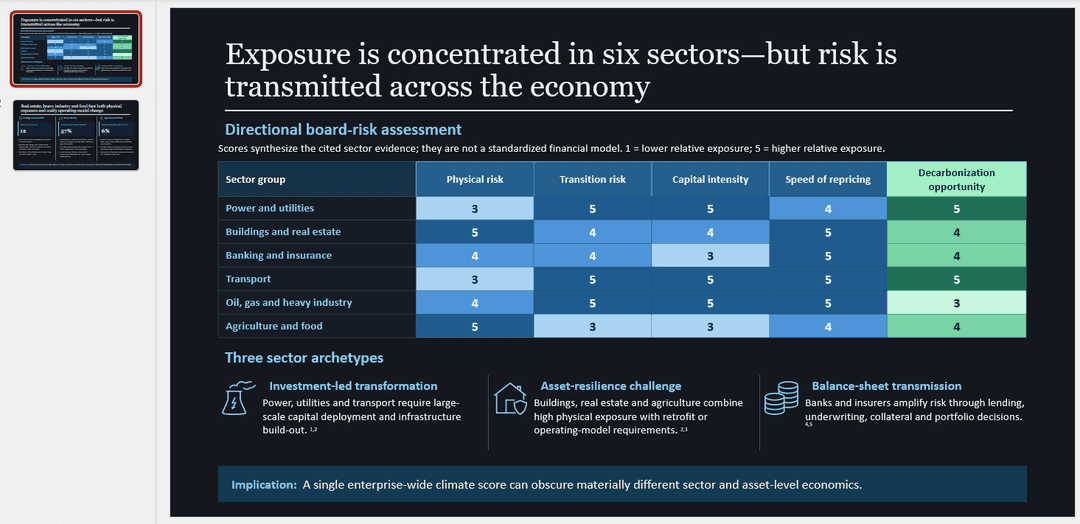
Slidely AI is designed to create simple, medium-density, and highly data-dense slides while keeping the result fully editable. Its examples include data-heavy graphs, tables, complex charts, and slides built directly against PowerPoint master layouts.
Rather than treating a predefined layout as the primary constraint, the workflow is designed around preserving the information the user has decided belongs on the slide and finding an appropriate way to present it.
Our take
Better: Slidely AI.
Both tools can generate professional, editable slides with charts and tables. Slidely AI is more oriented toward complex, information-dense PowerPoint work where preserving the requested content takes priority over fitting it into a standard slide pattern.
6. How fast and flexible is the creation workflow?
Generating a long presentation still takes time with any AI system. What matters is not only the absolute generation time, but whether the product keeps the user blocked while work is happening.
We looked at whether users can continue with other tasks, run work in parallel, and get notified when longer operations finish.
Plus AI
Plus AI typically generates a first draft in a few minutes. Its web experience lets users leave the generation screen and return later, and its API and MCP workflows support asynchronous runs that can be checked after they finish.
The core product experience is still more centered around individual generation or editing operations.
Slidely AI
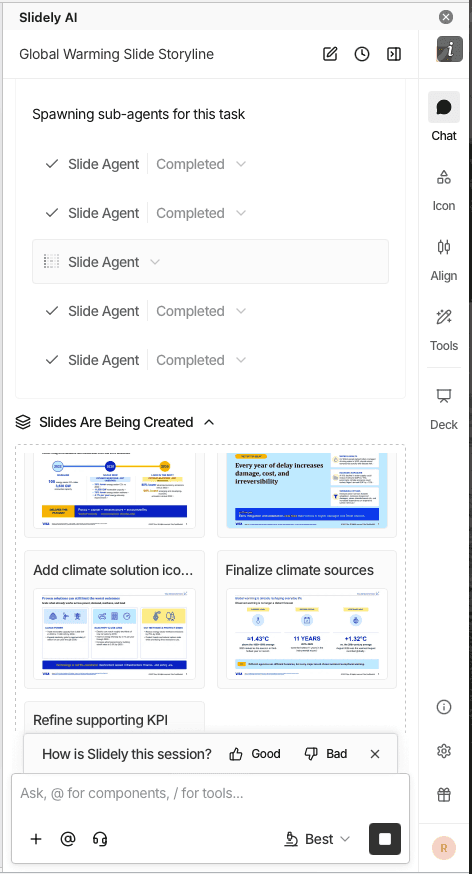
Slidely AI creates slides in parallel rather than waiting for one slide to finish before starting the next. It also supports multiple chat threads, allowing the user to work on different presentation tasks simultaneously.
For longer operations, Slidely has slide-completion and presentation-completion notifications so users do not need to keep watching the generation screen.
Our take
Better: Slidely AI.
Both products let users step away from longer generation tasks. Slidely AI goes further in treating presentation work as several parallel workstreams rather than one sequential interaction with the AI.
Branding, templates & design
Once the content is right, the next question is whether the output actually looks like it belongs to the company creating it.
For professional teams, branding is not just a logo, two colors, and a font. It is encoded in PowerPoint masters, layouts, reusable slide patterns, components, and hundreds of smaller design choices accumulated over time.
7. Can it use your real company template?
Many teams already have a professionally designed PowerPoint template. They do not need the AI to create a new design system; they need it to work correctly inside the one they already use.
We therefore looked at how easily each product can adopt an existing company or client template.
Plus AI

Plus AI supports custom branding on its Team plan and custom templates for more advanced workflows. Enterprise customers can use their organization's actual slides and slide masters, with Plus AI offering white-glove template conversion for complex designs.
The trade-off is setup. A normal PowerPoint template does not automatically work with Plus AI's designer out of the box, and complex Enterprise templates typically go through a conversion process.
Slidely AI
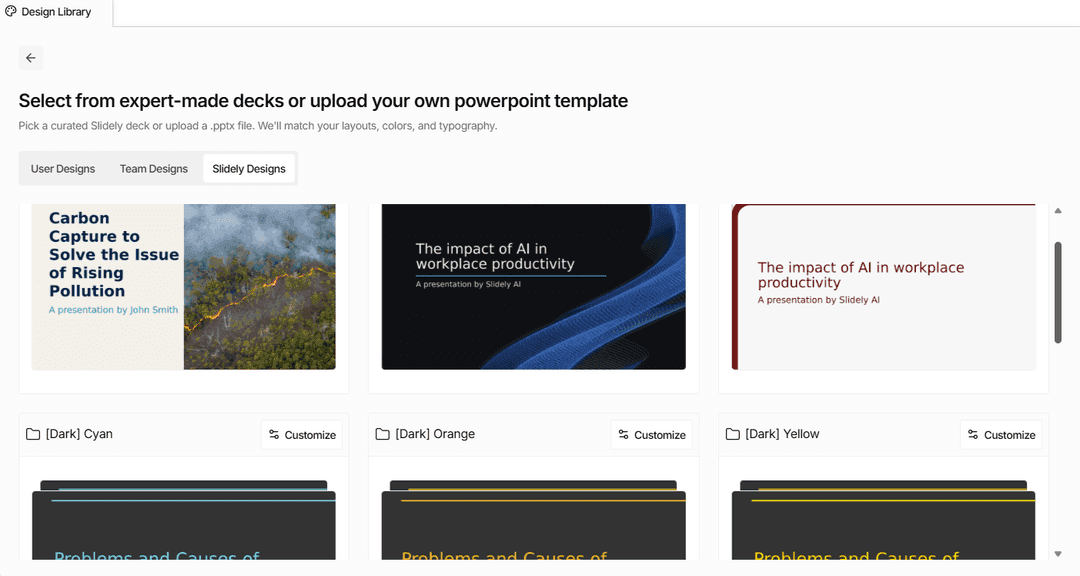
Slidely AI lets users upload an existing .pptx directly and use it as the design source. It reads the presentation's existing layouts, fonts, tables, charts, and other styling and uses them when generating new slides.
This makes the workflow closer to "give the AI the deck we already use" rather than first converting that deck into a separate AI template system.
Our take
Better: Slidely AI.
Both products support real corporate templates. Plus AI has a mature Enterprise template-conversion offering; Slidely AI offers a more direct workflow for using an existing PowerPoint deck as the design source.
8. Can it learn and reuse your company's design patterns and preferences?
A formal template only captures part of how a company actually designs slides. Teams also reuse KPI cards, table styles, timelines, process diagrams, chart treatments, section patterns, and dozens of other components that may never appear as formal PowerPoint layouts.
At the same time, individual users develop their own preferences about which patterns they like to use.
Plus AI
Plus AI supports custom instructions and presets that let users save context for future generations. Team and Enterprise offerings also include shared preset libraries, custom templates, and integrations with existing slide and asset libraries.
This gives organizations a way to encode repeatable presentation patterns into Plus AI rather than starting from scratch each time.
Slidely AI
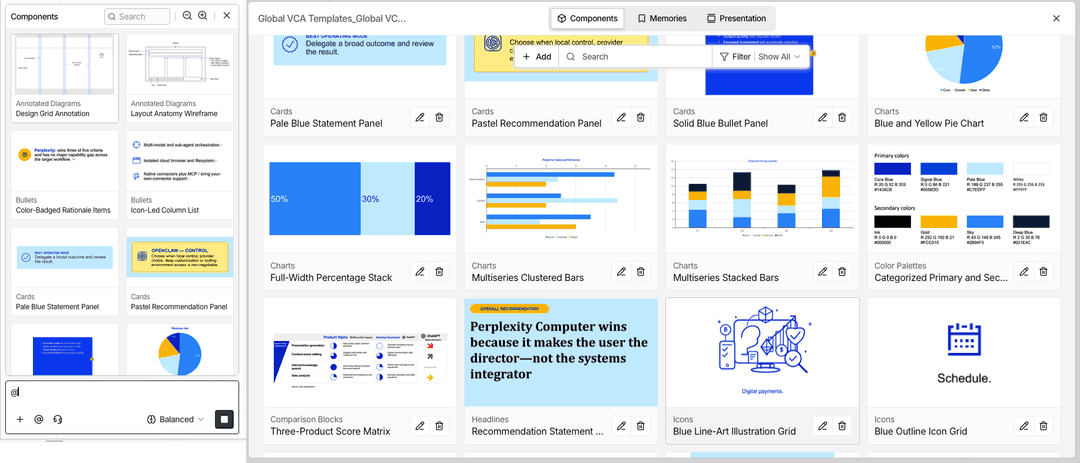
Slidely AI approaches this through both reusable design components and design memories. Components can be extracted from existing slides and reused in new compositions, while scoped design memories let Slidely retain preferences that should carry into later work.
This allows the AI to learn not just from an organization's formal template, but from the actual visual patterns and choices its users repeatedly make.
Our take
Better: Slidely AI.
Plus AI provides strong libraries, presets, and organization-level customization. Slidely AI puts more emphasis on learning from the actual slides and edits a user already makes, then reusing those patterns inside future work.
9. Can it help when you do not already have a usable template?
Sometimes there is no editable company template to begin with. A team might be pitching a prospect and only have the prospect's website, a PDF report, or a few public presentations as visual references.
In that case, the problem changes from "use this template" to "help me create a usable design system from the references I have."
Plus AI
Plus AI provides a library of professionally designed preset templates that users can customize with their own logo, colors, and fonts.
For Enterprise customers, Plus AI also offers white-glove template conversion and design services when a company needs a more specialized template built for its use case.
Slidely AI
Slidely AI also provides preset templates for users who simply want to pick a design and begin.
When the only reference is a PDF or other branded material, Slidely can additionally use those materials, alongside web research, to infer the visual language and create the PowerPoint masters, layouts, assets, colors, and typography needed for the presentation.
Our take
Tie.
The products are strong in different versions of this problem. Plus AI offers a polished preset library and a services-assisted route for custom Enterprise templates. Slidely AI is better suited to the more ad hoc case where the user wants the AI itself to reconstruct a PowerPoint design system from imperfect reference material.